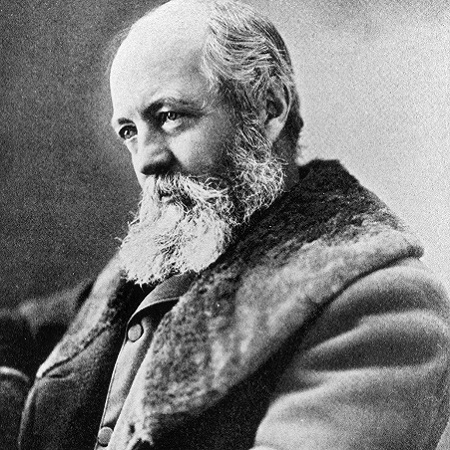
Frederick Law Olmsted
“The enjoyment of scenery employs the mind without fatigue and yet exercises it; tranquilizes it and yet enlivens it; and thus, through the influence of the mind over the body gives the effect of refreshing rest and reinvigoration to the whole system.” – Frederick Law OlmstedAlthough, Frederick Law Olmsted, throughout his professional life at various points, worked as a farmer, sailor, gold prospector, merchant, journalist, and administrator, the quintessential man for all seasons is most fondly remembered for his considerable contributions to landscape design. Olmsted, in fact, is widely heralded as “The Father of Landscape Design” having helped design some of North America’s most famous public parks.
Born in Hartford, CT in 1822, Olmsted took after his father’s love of nature from an early age. Olmsted’s father took young Frederick on many a carriage ride through the Connecticut countryside, giving birth to the boy’s lifelong love affair with the natural world. When a brief illness prevented Olmsted from attending Yale College, he set out on a series of worldly adventures that included working on merchant vessel bound for China, hiking 300 miles in England and Wales, and touring Europe’s finest parks.
Olmsted gained acclaim writing about his travels in England and in the American South before being awarded with the prestigious position of Superintendent of Central Park in New York City. As it existed prior to Olmsted’s tenure, Central Park was 700+ acres of swamp, overgrowth, and squalor. Inspired by the great European public gardens he had witnessed first hand, Olmsted forged a working partnership with Calvin Vaux (an English architect whom Olmsted would work with numerous times throughout his career) and turned Central Park into the natural wonder it is today in Manhattan.
After his work at Central Park, Olmsted spent time during the Civil War serving the head of the Sanitary Commission (the 1860′s equivalent to the Red Cross) and afterwards played a significant role in championing Yosemite as one of America’s first national parks.
Once he concluded his western exploits, Olmsted returned to the Big Apple to work on the majestic Prospect Park in Brooklyn (which always remained a project close to the architect’s heart). From the late 1860s up through the 1890s, the most formidable green thumb designed a plethora of landscape projects with and without Vaux (the pair dissolved their professional relationship in 1872).
Most notably, Olmsted designed the grounds at Harvard College, Mount Royal Park in Montreal, George Vanderbilt’s Biltmore Estate, and the gardens at the 1893 Columbian Exposition in Chicago, IL (as chronicled by Erik Larson in his best-selling book, The Devil in the White City).
More than a century after his death in 1903, millions of people enjoy the artistic creations Olmsted crafted out of the earth every year.
Sean Heffernen (http://www.ambius.com)